

This post is based on a chat with Tommy Dixon, winner of the 2025 Essay Architecture Prize, whose essay is featured in our anthology, The Best Internet Essays 2025. The book is being sold on Metalabel, where 100% of royalties go to the writers, judges, and the 2026 prize pool. Shipping is now planned for Monday, April 6th, so get your copy soon!
“We’ve become inverted headless horsemen: big floating heads, drifting and disembodied, restless and searching. Looking for our bodies. Bodies that have been taken from us. Bodies we lost somewhere along the way in the big promises of convenience and what actually makes us happy.”
—Tommy Dixon, Scrolling Alone
After 3 hours of talks, a 28-part email exchange that veered between letters and logistics, and building an app to analyze his 5-year backlog, I bring to you an essay about Tommy Dixon, winner of the essay prize I recently ran. It would be futile to synthesize a whole person into a short essay, so I decided to focus on one bit: floating heads. It’s a fun image, centuries-old, and yet more salient than ever.
The theme behind the metaphor, embodiment, has been poking through Tommy’s writing for years. “Scrolling Alone” was originally published in October of 2025 but it makes sense as the latest installment of a series. It was the follow-up to his 2024 essay, “the end of our extremely online era,” written from an off-grid cabin in Newfoundland, sitting on the floor, hooked up to a solar panel battery, clearly striking a nerve with 21,000+ likes. And that original essay is part of a cluster of works, all around rejecting the pace of Internet life and becoming more rooted, all written in a 10-month stretch. You can sense the theme from the titles alone: “slowness as an ideal,” “Be an animal,” “surroundings that speak of enchantment,” “Where to live,” “Building the Log Lodge,” “Real Life,” All of this came after Tommy committed to writing full-time, after rejecting a job on Wall Street, the natural conclusion of his finance degree. From essays like “workaholic,” you can tell he’s an analytical guy trying to get off screens and out of his head, into his body and a more analog existence. He told me a line from his friend, a line that seems to sum up the quest he’s on: “the biggest distance in the world is the distance between your head and your heart.”
Something surprised me though. Considering essays have been core to Tommy’s journey, and considering he’s so intentional about designing his life (including his lifetime reading plan) I did not expect his essay, “I can’t help but feel writing about life detaches me from living it.” I was worried he was right. He says there’s a “spiritual cost” to writing. From our talks, I sensed there’s both an intrinsic and extrinsic risk:
“Writing is an act of vanity, elevating the importance of your thoughts, making it easy to begin to worship your own intelligence—you care about feedback, people thinking you’re a good writer, not wanting attention to stop or go away … There is a certain Faustian bargain writers make, where their excessive introspection and ruthless observation lends to a stunning landscape of the soul, but elevates their interiority to a dizzying height, from which all they can do is fall.”
This might explain why Tommy hides his Substack metrics, or why he said he was “somewhat horrified” to learn he won this essay prize. He knows the disorientation of attention,1 the danger of a validation spiral, and is wise enough to try to keep things small. “I just want to write thoughtful, cozy kitchen-table essays that a few people read with a coffee.”
Part of my goal here is to make sense of this paradox, that writing can be both liberating and alienating. The truth is definitely more complex than “embodiment = good, abstraction = evil,” and so I want to think it through and find the critical nuance, the way forward. When is it okay to retreat into your head?
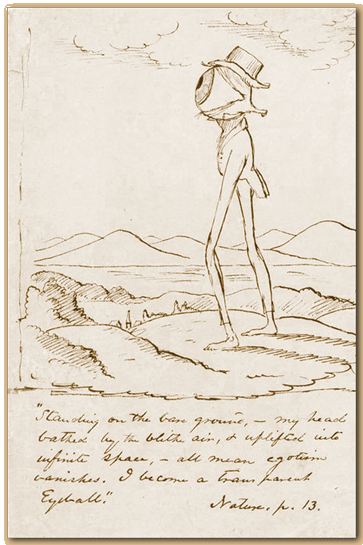
Back to floating heads: This is the default shape for a citizen in a screen-addled culture, but it has a history in describing the shape of the writer, the artist, and the mystic too. I’m sure there are instances before Emerson, but this passage from “Nature” (1836) is my personal sense of the origin: “Standing on the bare ground,—my head bathed by the blithe air, and uplifted into infinite space, —all mean egotism vanishes. I become a transparent eye-ball; I am nothing; I see all; the currents of the Universal Being circulate through me; I am part or particle of God.” Here, he frames it as a positive: the loss of body, and the reduction of a self to a pure and total perception, can lead to transcendence. Naturally, he was criticized. His friend Christopher Pearse Cranch (another Transcendentalist), made a caricature of this idea: a sketch of a giant eyeball in a tophat, a suit, and long slender legs, levitating above and wandering through a barren landscape. In other works of the 19th century (from Hawthorne to Dickinson to Melville), you find the sentiment that reducing yourself to a disembodied gaze will corrupt, blind, and eventually kill you.
A modern incarnation of this phrase comes from David Foster Wallace in his 1997 interview with Charlie Rose: “The things in this [essay] book that most people like are the sensuous or experiential essays, which is basically an enormous eyeball floating around something, reporting what it sees.” Both Tommy and I are fans of DFW, but he noted, “he’s very sharp and critical and funny, and he’s right in a lot of ways. But in another sense, it’s just another way of abstraction. It’s another way of keeping reality at an arm’s length.” DFW defined a style of hyper-aware self-conscious writing, an anxious person in an anxious place, yearning for authentic connection but never finding it. It’s fascinating to occupy his headspace, but it’s probably not the default state you’d want to live in. I imagine he was such a great essayist because of his background (focused on fiction, educated in philosophy, raised by language snoots), but maybe his crutch was that all his essays were commissioned by magazines.2 The premise is often let’s send this extremely articulate guy into an extreme place to make sense of it. And so we see him on a cruise ship, at the lobster fair, in the porn convention, along the McCain campaign… we see his assignments, but rarely the particularities of his life on the average day (his relationships, his job as a teacher…). There is one essay written from his home in Bloomington, Illinois, but it was 9/11. We mostly know about his life through interviews, letters, and biographies. While his essays did feature highly personal, unbelievably lucid, 5/5 experiences, they were outliers: stunning and prescient portraits of our culture, but nothing he’d ever do twice. It’s even in the title of his first essay book, “A supposedly fun thing I’ll never do again.”
You can see how being extremely in your head in alienating places can be fun, shocking, legendary, but also disembodying. The opposite of this is being rooted in a sense of place, something Tommy eventually wrote his way into:
“The first three, maybe three and a half years of my writing, a lot of it was writing about abstract ideas—there was no onus or responsibility. Even my parents who love me more than anyone were like, man, you’re writing about this stuff, but we want to see you live some of this more. One of my goals for 2025 was to write more as ethos. I wanted my essays to be deeply rooted in how I lived my life, not forgotten philosophical pandering.”
There is probably something important in starting essays from the actual circumstances of your life, rather than retroactively finding stories to fit an idea, framework, theory, or phenomenon. While Essay Architecture asks what are the composition qualities of great essays?, Tommy is helping point me towards the question of which essays should you actually write? In an over-simplified and instructional way, I guess this comes down to topic selection. Are you writing about stuff that matters to you? Or are you misled by your own writerly identity, writing the things you think you should be writing?
Maybe the point of an essay isn’t to help you think better, but to help you live better. It’s a simple but radical departure from the trope. If the point of writing is to sharpen your mind, to communicate better, to make you smarter, to enable you to rotate ideas until you can effortlessly find the counterpoints, then isn’t that an exercise in expanding your already-endlessly-expanding head? Maybe essays are less about cognitive sharpening and more about navigation. Where should you be? What do you value? Who matters? When should you stop? Why bother? If you’re going to spend 10 or 20 or 100 hours expressing some idea as elegantly as you can, it might as well be a one that’s aligned to your situation, because any idea you spend so much time with is bound to slant your vision. If the point of writing is to unlock some dimension of our life, then the resulting artifact of words, the essay, is just an incidental bonus.
This might sound too pragmatic, too self-serving, but if you’re not deeply entangled in a topic, you can’t possibly know it in a way that’s specific enough to resonate. Tommy:
“In order to touch people’s lives and to actually move people’s hearts in a way that is life-giving, you kind of have to selfishly write about the things that you’re interested in and only through that can you breathe enough life into them. [ … ] Everyone wants to change the world, but no one wants to change himself. You have to start on the level of the individual... put yourself together first, then your family, then your community. That’s where change can really be effected.”
It’s very easy to get caught up in external metrics—to judge ourselves by the impact or visibility of our work—, and it’s also easy to think that spiraling through an abyss of thought is productive too, but it feels important to remember that, when we write, all we really need to do is solve our own problems, follow our own questions. This approach makes an essay practice maximally approachable, a true folk medium. You do not have to be a professional writer. The majority of the writers in The Best Internet Essays 2025—if not the entirety—are not full-time writers. As of March of 2025, Tommy got a full-time job. He originally thought he needed complete freedom over his time to write, but he’s since found the opposite: the stability of a job lets him protect his practice and stay focused on ethos. He assumed he’d only be able to write for two hours a week (probably on weekends), but he found the practice so ingrained that he couldn’t help but write a whole lot more: “I think it does become fundamental to how you process the world in a way that you can’t just rip out.”
Now that I’ve written all this, it’s helping me clarify when I should shift into abstraction, when I should embrace being a big floating head. If I’m going to retreat from life and spend a considerable amount of time in the inner caves of mind, it should be towards something that refines my character when I return, Bodhisattva style.3 Life in retrospect is a palette of fuzzy and undigested experiences, and I can’t properly process them without solitude. By logging my days at the highest resolution I can, the on-the-page abstractions will be an approximation of me. This leaves me with atomic blocks of words that I can interrogate, re-arrange, disprove, expand upon, all towards the end of finding a new insight, a lens for my future self to experiment with. Like a hot air balloon, the floating head comes back down. When writing starts and ends with the ground reality of your life, then the essay is a path towards self-guided evolution:
“In an ideal world, you as a writer and you as a human being exist in a kind of ecology. You can write your way into development, and then that more developed person can write further things, and it’s like an upwardly ascending spiral. I was thinking of Thomas Merton, a Catholic monk—in some ways, he wrote himself into faith: he wrote about his belief in God, until he started to believe in God. [ … ] As I’ve tried to put more emphasis on writing as ethos, and writing about ideas that become fundamental to the man I’m becoming and not just a kind of periphery safe intellectualizing, I’ll notice these things coming up in the day-to-day, coming up in conversations… like I find myself actually absorbing these words, and that seems a lot more meaningful to me. And it’s a more meaningful stance to take as a writer: I’m going to write my way into a beautiful existence.
Footnotes:
It’s interesting how writers get annoyed at both crickets and virality. What they share is an inability to control the attention towards you. While the introvert can control whether they explore or retreat, they have no control in the reception of their work. They’d prefer to have no eyes on their work when they’re not consumed with an idea, and many eyes on them for a limited period, when an idea feels most alive. Constant attention is draining in the way that forced social gatherings are draining when you prefer to be in solitude.
Even though David Foster Wallace emerged as an essayist right when the Internet emerged, he never had a blog, never needed to self-publish considering the success of Infinite Jest in 1996. I wonder how that would’ve changed things.
I’m using this term loosely. A Boddhisatva is a Buddhist term for a (rare) devotee who forgoes their own personal enlightnemenet and returns to the world to help others (in some cases, all others). Instead of going deeper into silence and private meditation, they choose to return to the chaos of society, because they realize the separation between them and others is an illusion. You can’t be liberated while others suffer. This obviously diverges from essay writing in many significant ways, but the parallels I like are (1) the retreat-and-return dynamic, and (2) the idea that going inward can provide insight to help others.
“There is a certain Faustian bargain writers make, where their excessive introspection and ruthless observation lends to a stunning landscape of the soul, but elevates their interiority to a dizzying height, from which all they can do is fall.”
Beautifully named, terrifyingly felt.
It's funny of course to be gazing at / through the screen to read and to comment. Am I in my body? In recent years, I've become skilled enough that I can actually be in my body while I read or write but I do need to remind myself.
I think that Cranch teases Emerson with that illustration and possibly does him a disservice. The "transparent eyeball" (which I understood not at all when I first came across it in high school) now reads like a description of a deep meditation experience — not disembodiment, rather deep attunement or awareness of the informative sensations that run through all of us. Though Western Civ does an excellent job of training us to be unaware.
This zen koan speaks to what I'm getting at:
Yunyan asked Daowu, “How does Guanyin use all those hands
and eyes?”
Daowu answered, “It’s like feeling behind you for a pillow in the middle of the night.”
“I understand.”
“What do you understand?”
“The whole body is hands and eyes.”
“That’s very well expressed, but it doesn't say it all.”
“What would you say, older brother?”
“All through the body are hands and eyes.”
—Blue Cliff Record Case 89
(transl. by John Tarrant & Joan Sutherland)