

A few years ago I had a weird experience, filled with synchronicities, that I’ve since wanted to turn into an essay. Halloween feels as good a time as any to write and share it.
Some quick updates and then we’ll get right into it: (1) we’re in the middle of our fall syllabus of Essay Club, and everyone’s invited to join one free session; (2) I’m building v2 of my editing software, and you’d help me a lot by filling out this survey; and (3) Best Internet Essays has a new website and new concept, more info coming soon.
Okay, story time. (If you don’t want to get spooked, feel free to skip this one.)
I
After missing a 7:30 PM start of The Tempest by just a few minutes, my wife and I wandered into a London pub and found ourselves in a multi-hour conversation with someone I’d later describe as a witch. Her name was Sylvia. I met her when I returned from the bathroom; she was sitting in my chair stroking my wife’s hair. It was our first ever trip to the UK, first ever pub with quaint British charm, and I just assumed I lucked out, blessed with a chance to meet an archetypal crazy lady, the kind of eccentric character you imagine in a 19th-century occult novel, but not expecting that she was in fact versed in black magic and going to use it on me.
I wish I could remember all the quirky small talk that led up to her extraordinary claim: she had a Ring doorbell and saw a demon looking through it. Sylvia was older, said she had kids my age, in town for a farmer’s protest, and from west of Oxford (where I’d just been). I explained we were there because I won an essay contest affiliated with Oxford, and brought my wife along for an extra week to celebrate our anniversary. She was forward, but seemed harmless: the first thing she did was introduce us to her stuffed animal, a little sheep she brings with her everywhere. We quickly saw her range in personality. She was mysteriously charismatic, breaking conversation to chime into an adjacent group and trigger an uproar, only to come right back and sternly snap at the bartender for a delayed wine order. Around thirty minutes in, her cheer turned to a stone face with spooked eyes, and she insisted she show us her doorbell footage.
I declined. Demons—and all things supernatural—are probably my ultimate source of fear, and I was in no mood to see video evidence. (This probably started as a teenager, ironically, at Greek Orthodox sleepaway camp, where counselors would scare us with tales of the supernatural happenings on campus in years past, including demonic possession.) Sylvia’s footage was probably explainable, due to smudges or static, a prank or delusion, but whatever it was, I didn’t want to etch that gestalt into my mind.
This didn’t stop her from describing her demon in explicit detail: “black skin... and, and terrible horns... and beady little eyes on that demon...” She went on and on, speculating why the demon came, what it wanted, how it hacked her Netflix and email and other accounts, how it would mess with her electricity when it came near, but she’d always loop back to those same three features... the black skin, terrible horns, and beady little eyes. After the fourth or fifth loop, I felt like I was being hypnotized, psychically attacked without permission, and so I uncharacteristically yelled at her, “ENOUGH!”
We moved on and talked for another hour about politics and who knows what else, before she confessed she was cursed with “special gifts.” She seemed ambivalent about them. It brought her pleasure to get “transmissions,” to peer into the secrets of the universe or whatever, but it’s made her a bit of a pariah. She explained that young couples, just like us, frequently leave this bar in a hurry, crying or screaming.
She offered to read our past and reveal our future, and even said she understood if we weren’t comfortable, only to then niggle us for not being curious. My wife went first. She started crying as detail after detail correctly unfolded, each describing her childhood and parent’s divorce in odd specifics. The spook was escalating. I looked over to my wife to see if it was time to GTFO, but Sylvia was endlessly interesting, and both of us were hooked. We were American tourists, prey.
My turn. After more insistence, I agreed to let her have a go at my future. “What do you want to know?” I mentioned that my wife and I were trying to have kids for a year and were struggling. She paused, tapped into her hivemind I suppose, and insisted we’d go on to have a happy family and normal life. But she wanted more: “Come on—what do you really want to know?” She already knew from our conversation that I was obsessed with essays, studying classics, teaching classes, building an audience, writing every day, often with a typewriter, and aspired to make great works... so I sheepishly asked, “Well, where will my writing take me?”
She let out a terrible heckle and couldn’t stop laughing. It’s possibly the rudest thing a stranger could do, to doubt your dream so much that they completely lose their composure in front of you. I was less offended than concerned, because for the rest of our time together, at least 10 minutes, she was possessed with inconsolable, uncontrollable, high-pitched shrieking. She’d calm down for a few seconds to try to articulate herself. She showed worry and regret in her face, giving an earnest, “My god, I’m so sorry my dear. It’s just that—” and then she’d erupt again.
It was time to go. My wife and I gave each other the nod, and gave Sylvia a polite excuse to exit, and Sylvia gave me a final cryptic remark: “I’ll see you soon, dear.”
II
Outside now in the winter night, after our calm composure in the pub, my wife and I revealed to each other how absolutely freaked out we were. It was like those David Blaine memes, where people lose their mind from unexplainable tricks. “Why didn’t we leave immediately?” Sylvia felt too singular, too idiosyncratic to walk out on, but I wondered if we’d regret it. Did she drug my wife? Were we cursed? Paranoia had us spiraling through every possible explanation. Was she following us? I looked down at the business card she’d given me, unsure if it had tracking chips or voodoo, and impulsively chucked it in a garbage can around the corner. By doing this, I’d never talk to her again, never get closure on the oddities of that night, until I suddenly got a text. It was my dad:
“Hi Michael. I hope you’re having fun in London. FYI, Mr. Boyd has an old Underwood typewriter (similar to the one in the photo) that he wants to get rid of. He heard that you are interested in typewriters and is willing to give it to you.”
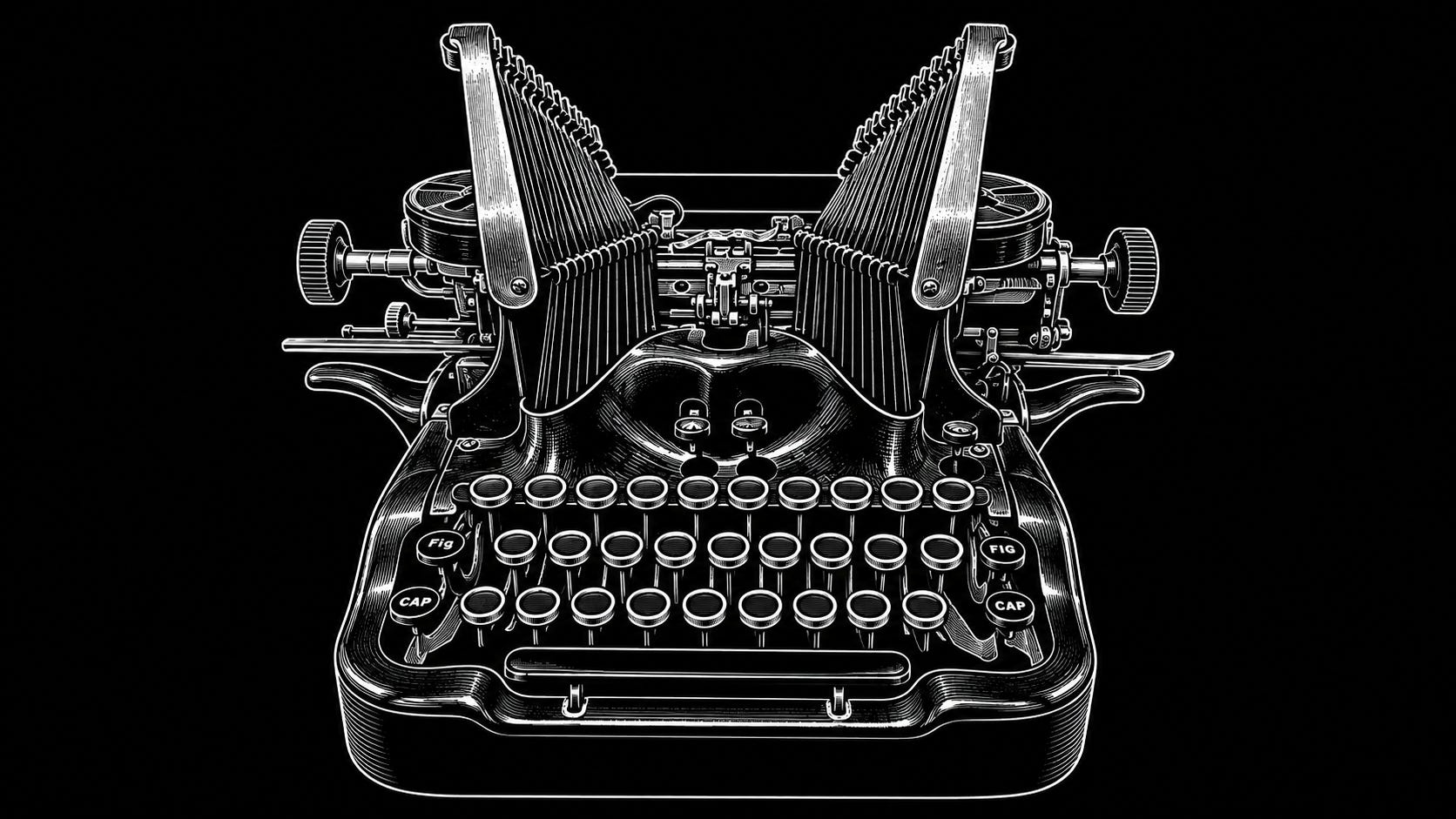
The machine in the picture had black glossy paint over a curvilinear, Gaudi-like body, with metal prongs which were not hidden within an exterior chassis like most typewriters, but flared upwards, 14 keys each side, bundling into two terrible horns, and punctured right in the middle were two buttons with no ascertainable function, which of course looked like two beady little eyes. I noticed that “Underwood” was a simple twist from “underworld,” where this typewriter could conceivably be from. If you’ve ever read or seen Naked Lunch, where the character based on William S. Burroughs collects typewriters that look like cockroaches, and talk to you, and ooze hallucinogenic pus and moan as you type, then you know how grotesque, evil, and unsettling a writing device can be. This one was worse. This typewriter had the face of Sylvia’s doorbell demon.
(After some research, I learned that this design was made by Olivetti in the 1890s, and a Redditor described it as “too creepy to bring into your home.”)
When we got back to our hotel room—which was itself a disquieting place: our first room had tormented art and a flyer for a Marina Abramovic event (the “spirit cooker”), so we requested a transfer—I laid awake in bed with pulsating full-body chills until 5 AM. I’d be drained for our anniversary day. I couldn’t shake the feeling that Sylvia had summoned this machine. From my state of irrational dread, I traced back my steps in Oxford, trying to remember if anything unusual might have brought on a curse. Not only did I have to process the incredible synchronicity unfolding, but I had a decision to make: would I accept this typewriter from hell from my uncle’s brother-in-law?
The weirdness continued... I went to write into my phone to recount what happened that night, only to find my last note from earlier that morning, eerily titled, “Evil thoughts from good men.” It was a title idea and premise for a novel, and the day had unfolded to give me the perfect opening: the protagonist strives to live a virtuous life, but is plagued by a recurring demonic presence in their psyche; instead of ignoring it, they venture into “automatic writing” to give the shadow an outlet—what better catalyst than the uncanny arrival of a haunted typewriter?
The concept of evil was on my mind because, a few weeks before, I had a disturbing daydream at a coworker’s wedding. We were in a small church filled with jubilant people, and at the height of innocence, with the organ blaring and Christ’s name being chanted, I had a ten-second flash of an orc-like demon bursting through the front doors, large and disfigured with a trail of carnage as its body perpetually disassembled and reformed, here for murderous orgy, impaling bridesmaids with its four-foot-long metallic deathpecker, telepathically bending the organ tones and controlling the attendees, now with rolled-back eyes, to unzip and join the frenzy, all witnessed in abysmal horror by the bride and groom, watching their ceremony descend into pandemonium. I wouldn’t wish this upon my friends! It was very uncharacteristic of me: I aspire to see each moment with clarity and love and potential; so why did that pop into my head, autonomous action, fully crystallized, as lucid as a Rembrandt painting? Obviously I’m not evil (I don’t choose or enjoy cruelty). But why does my imagination have a satanic underbelly?
Fear, I think. To fear demons is to let them brew outside your awareness. The thing you’re most afraid of, the thing you repress, the thing you can’t bare to look at, is eventually the thing that incubates and explodes from your subconscious with vividness, emotional charge, and aesthetic strangeness: the very qualities associated with great art. This is my dilemma. My prudent avoidance of evil—ie: the avoidance of Sylvia’s doorbell footage, along with David Lynch movies, Rosemary’s Baby, H.P. Lovecraft, despite all their intrigue—has created a pressure cooker where evil is now a subject matter of tremendous charge for me. There’s a continent of demons hiding in my mind, waiting to be written in menacing exactitude. Heironymous Bosch comes to mind. He’s known for The Garden of Earthly Delights and other paintings of strange landscapes, grotesque demons, and eternal damnation—he was also a Christian. No one knows his intentions, but people speculate that he rendered Hell to purge his mind and to scare people into living more virtuously. Despite any potential merit in the project, I can’t imagine that an artistic obsession with demons doesn’t poison the psyche and corrupt your way of thinking and seeing.
C.S. Lewis actually tried an experiment like this, too. Written from Oxford (wow) in 1941, he published a weekly edition of The Screwtape Letters, a satire from the perspective of the Senior Demon in Hells’ bureaucracy. Channeling evil, and writing through the devil’s voice, he gave advice to lower demons on how to corrupt good men by getting them to commit small sins so that they could devour them. He said it was the easiest thing he ever wrote, and also the least enjoyable. It was draining to enter diabolical moods for the sake of his work, and so he refused to extend the series despite how popular it was. In his preface, he warned his readers to not become fascinated with this stuff.
As we walked around London the next day for our anniversary, in little moments of quiet on long walks around the city, I debated with myself if I should make Evil Thoughts from Good Men a project. It felt obviously dangerous, but undeniably intriguing. If the answer would be yes, then I should accept the typewriter. It was a machine made for the job, a tactile reminder to induce chills and invert my default mode of writing. Instead of writing from a place of virtue and control, I’d—reluctantly—write from a place of possession. Typewriters have minds of their own. In Naked Lunch, Bill Lee doesn’t just have an exotic insectoid typewriter from Tangier, he completely surrenders to it, having no control of the material being channeled. He’s in a trance, effectively blacked out, with no memory of the experience. SPOILER: The story ends with his pals (Ginsberg and Kerouac) finding him as a shell of himself, but holding a shimmering manuscript, an inter-dimensional work, the weirdest thing ever written, a literary achievement, yet he was sick and incoherent. This is the writer’s Faustian bargain: do you give up control and risk your sanity in pursuit of aesthetic novelty?
We usually talk about possession metaphorically, but I mean it literally. It’s not just “you’re so interested in something to the point you don’t want to stop,” but more like “something has taken control of your body and you can’t even make decisions.” This sounds like fantasy until it happens to you. It happened to me, only once. But once is enough to become seriously cautious of esoteric realms. It happened about two years before I went to Oxford… As I’m drifting to bed, I’ll sometimes get a sensation of bodily paralysis, along with the feeling that I’m about to get sucked out of my own head. It’s scary, and so I usually abort. I wiggle myself awake. One night though, I surrendered to the pull, and it led to twenty consecutive out-of-body experiences. My perception would tunnel out of my body and twist into a different location in my house, but as soon as I stabilized in an “astral body,” I’d get dragged by a cord back into my paralyzed body, only to be launched again, over and over. This is what I imagined “shamanic flight” might be, except I was a novice with a jet engine crashing into walls. The ordeal culminated in the kitchen, where I found a paranormal force switching the lamps on and off.
I haven’t surrendered to the tug since. I wiggle out of it, every time. It feels like I’m getting to the actual root of all this: insanity. I’m not scared of the physical existence of the Devil & Co., but the hallucinatory power of my the mind, and the possibility of losing control over it. Behind my OCD, my analytical mind, my world of frameworks, my architecture of everything, is the potential to immerse myself in something very different: a surreal and unexplainable shamanic odyssey—if I were open to it. Currently I’m not. Something rings my doorbell at night, and I decline. This is the temptation of Sylvia’s offer: to loosen control, to launch into the heart of the world I fear so that I can rid myself of it.
III
Two nights after meeting Sylvia, we landed back in New York with only seven days until the Thanksgiving dinner where Mr. Boyd would show up with a typewriter. I wasn’t much closer to making a decision. If I remained meek and eager to please my family friend, I’d end up with a demon permanently in my trunk. I sought my writing friends for advice.
I explained the ordeal and then offered to show them the picture, but only before warning them how haunting it was. C— agreed to see it, and two years later told me that the image is still seared in his mind (if you don’t want to see an illustration of the photo, don’t scroll past “END” at the bottom). C— is probably the most erudite person I know, and was quick to warn me that Oxford is an area historically associated with black magic. I did some research, and aside from general reports of prophecies, evil spirits, necromantic handbooks on how to bind spirits into physical talismans, there are more specific parallels, like the novels of Charles Williams published through Oxford University Press, about ordinary English people stumbling into objects of supernatural power and having a crisis over what do to with them.
All of the synchronicities were too much to bear. Was this my destiny? I thought. At the time, I didn’t even know the plot of The Tempest, the play I wanted to see. It featured a horned, black-skinned demon, a witch-hag named Sycorax who sublimates spirits into objects, and a protagonist, Prospero, who has to decide whether to use his magical powers or not. I missed the play, but it’s as if I were meant to live it. It all felt a bit insane. And speaking of destiny, all I had to do was look at my own name: Michael, a very popular name, but still, a name tied to St. Michael, the saint who has to, uh, fight the devil.
Another friend, E— said to get the thing inspected by a shaman before I decide.
G—, a lucid dreamer and fellow oneironaut, thought I should take the typewriter. To him, it was a plunge I needed to take. We talked about Jung’s idea of the shadow, and how if you avoid it, it controls you. In the end, it’s all in my head. The demon has no external reality; it’s more so a personification of my concept of evil, and I have control over how I relate to it. The mistake is in seeing it as an external object; it’s really an extension of me as a subject. I think this is what Jung means by “integration”: you see it not as a supernatural predator, but a fixable distortion of yourself.
The reward of doing this is not in pages of shockingly strange demon literature. The reward is actually nothing to do with writing. The reward is gaining the courage to navigate through the unknown corners of my psyche, knowing that, no matter what I encounter, it won’t threaten my virtues or my sanity. For almost two decades now, I’ve been called to try psychedelics, and yet I’ve avoided them (for the fear of unleashing something dark I’ll never recover from). The goal is not to seek the demon, but to build the courage to enter the woods, despite the occasional one.
I was open to accepting the typewriter.
Thanksgiving day, from my aunt’s dining room table, I saw Mr. Boyd pull up and take a box out of his trunk. I imagined him unpacking the beast in front of my whole family, right on the table, with everyone crowding around it going whoa, cool!, somehow not acknowledging the thing was a demon, thinking nothing of its black skin, terrible horns, and beady little eyes, not noticing the clocks spinning in reverse, or the high-pitched ringing, or the fact that it started typing on its own. Of course, none of that happened. In fact, Mr. Boyd didn’t even bring the typewriter. The box was for something else; it totally slipped his mind. I did not bring up my ordeal (I didn’t feel like unraveling my occult conspiracy theory during a wholesome occasion). I asked Mr. Boyd where he found it and he said he got it for free at a yard sale, thinking he could flip it. But it seemed like nobody wanted it. He had no idea if it even worked. I figured if it was meant to be, it would come back to me later.
The next day I called Gramercy Typewriter in NYC to see if they could even service an Underwood from sometime between 1890 and 1930. It’s the place I go to try and buy typewriters, the only one I know of in the city. I sent them my terrible picture, and they said they had no idea how to fix a typewriter like this.
Mr. Boyd never brought it up again, and neither did I.
As I type this sentence, almost two years later in the last hour of Halloween, I still don’t know exactly how to manage this tension between wanting to foster purity while also harboring curiosity for the macabre. Maybe I have a theory, but I haven’t lived it. The answer is probably not total immersion, nor total avoidance, either. I also don’t need any special machine, I just need to follow the fear. Is this the purpose of October, of Halloween? I mean, like all holidays, we tend to forget the purpose and get lost in customs and costumes. Today I was a pirate and my daughter was an adorable parrot. There was sugar. For basically my whole life I’ve ignored and denounced this holiday, but now I see an opening, once a year, to earnestly engage with something that meaningfully frightens me. Like all festivals, it’s permission to engage the taboo within a boundary, without letting it seep into everyday life. When I’ve tried starting this idea in the past, I’d get spooked and put it down; but getting spooked is the very point of this time of year, and so writing this at all is a step forward. As I try to wrap this essay, the AC murmurs, and the string lights to my right flicker, and I wonder if Sylvia is remote viewing into my kitchen, reading my essay and laughing, and I get another wave of chills. I cringe at confessing paranoid logic like this. I know it isn’t true, but I feel it as if it were. Of course the real Sylvia is not really a witch, but when Sylvia the character loops in my mind a thousand times and appears in my essay, claws into the themes that matter to me, she practically is. As much as she spooked me, I probably owe her thanks for triggering an adventure that’s getting me to slowly face and reframe my fear. Recalling and writing this over the last three days has brought full-body chills at least a hundred times. The chills are a strange barometer. I get the chills from the peak of a Radiohead song, from looking at great paintings, from a great Virginia Woolf sentence. Despite my essay framework of 27 patterns, the ultimate way I judge an essay is to see if it gives me the chills. Isn’t it strange that contemplating demons pushes this same signal into overdrive? It comes from beauty or terror. Art or its opposite. Are they opposites though? Is great art not overpowering to the point of being eerie, conspiratorial in the sense that everything connects to everything beyond your conscious understanding? Now I hear the chimes ring on our own Ring doorbell (for real, the final synchronicity). Who is here this late? Chills, again. Late night Amazon, right? Our downstairs landlord’s daughter back from a night out? The demon? I imagine looking through the digital peephole and seeing what Sylvia saw, what she tried to show me, the black face, the terrible horns, the beady little eyes—except when I look I see a doppelgänger of myself, and so this time I open the door and invite myself inside, walk it up two flights of stairs to the upper attic, where I keep my typewriter collection, and it shapeshifts and jangles into an Underwood, and that’s when I blindfold myself and sink my fingers into its teeth, waiting for strange images like a fisherman, narrating what I see, to automatically transcribe the transmissions, regardless of what comes through.
END
Thanks to Garrett, Chris, Esha and Yehudis for feedback on this essay.
A free session of Essay Club? Great!
If what came out of the typewriter represented complete surrender to the demon it probably could not ethically be published and there may be a not-so-secret hope that it represented your struggle with the demon or your power to make the demon give you things you want.